
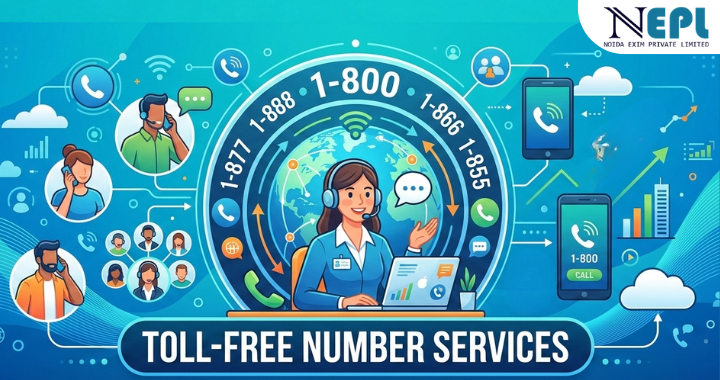
In an environment where brand success is all about customer experience, companies are always seeking solutions to bridge the gap between themselves and their customers. A tool that cannot be done without is the use of toll-free services, a communication medium that increases accessibility whilefostering trust and credibility.
Since the emergence of startups, toll-free numbers have ceased to be mere points of contact and have become strategic assets that drive customer engagement, loyalty, and conversions. Whether you operate a small online business or a global corporation, a toll-free number indicates to your potential customers that your company is in business, friendly, and willing to assist.
However, what are toll-free services, how do they work, and why do they seem to be more applicable today than ever before? Now, we will immerse ourselves in the world of toll-free communication and discover how firms can leverage it to build stronger customer relationships.
What Are Toll-Free Services?
Toll-free services enable customers to call a business without incurring charges. These numbers start with 800, 888, 877, or 866, depending on the location.
When a customer makes a toll-free call, the call is routed to the phone system, call center, or IVR (Interactive Voice Response) configured at the company. A toll-free system will ensure that the customer’s call reaches the appropriate department or representative.
The common consumers of toll-free number services are:
- Customer support centers
- Sales and marketing departments.
- Feedback and helpline systems.
- Units of scheduling of appointments or processing of orders.
The basic concept is straightforward: facilitate easy access for customers.
Understanding the Psychology Behind Toll-Free Numbers.
Not only does toll-free number service make it easier to make calls, but it also creates psychological trust. Whenever customers see a toll-free number, they automatically associate it with professionalism, reliability, and legitimacy.
Consider the following: could you call a local mobile number or a well-organized toll-free number, such as 1800-XXX-XXXX, when calling a company? The latter is more plausible and structured immediately.
Additionally, communication costs are another hindrance you can eliminate by using toll-free services. To a customer, the free call charge signals a brand that is more concerned with accessibility and customer satisfaction than with making profits.
That is why companies outsource toll-free number services to receive more customer inquiries and higher customer satisfaction rates.
Main Advantages of Toll-Free Number Services
- Increases Brand Image and Credibility.
The toll-free number service indicates that your business is established, customer-oriented, and available. It provides your company with a national presence.
Credibility in industries such as finance, healthcare, and technology is key, and toll-free services will immediately boost your brand image.
- Enhances Customer Service Productivity.
Toll-free services are state-of-the-art features such as call routing, IVR, and an analytics dashboard. These features ensure that calls are routed to the appropriate team and agents respond to customer queries quickly.
- Boosts Marketing Campaigns
The toll-free numbers are memorable and can be a potent means of marketing campaigns. Vanity numbers such as 1-800-FLOWERS or 1-800-PIZZA are common in businesses to build brand recognition and encourage interaction.
By recalling how to access you, the customer will automatically have a higher conversion rate.
- Enables Nationwide Reach
It is true with toll-free number services, where your business is no longer limited to a specific location. There is no cost to customers nationwide who can contact you, which would allow your company to increase its presence and reach new markets.
- Brings Valuable Call Analytics
Cloud-based modern toll-free number services offer sophisticated reporting capabilities. You can track:
- Call volumes and peak hours
- The physical location of callers.
- Agent performance metrics
- Missed or dropped call rates
These lessons can help companies improve their customer service and maximize the effectiveness of their marketing campaigns.
History of Toll-Free Number Services.
Toll-free services were restricted in earlier days to large companies, as the cost of operation was very high and a complex infrastructure was necessary. They used the old methods of landlines and manual routing; thus, scaling was a problem.
But the emergence of cloud telephony has transformed the toll-free services. The solutions available today are cheap, diverse, and comprehensive- even those that may suit small and medium-sized businesses.
Nowadays, when businesses outsource toll-free number services, they see significant changes, including:
- Cloud-Based Management: No need to install expensive on-premises hardware. Everything is on the cloud.
- CRM integration: Toll-free systems can now be integrated with customer relationship management tools, enabling personal interaction.
- Omnichannel Support: Customers can submit inquiries via voice, chat, or email on the same platform.
- Intelligent Dashboards: Artificial intelligence (AI) embedded in smart dashboards will provide predictions and help enhance customer service delivery.
Which Industries Benefits from Toll-Free Number Services?
- E-commerce and Retail
Customer service is very important to online shoppers who need fast, dependable customer care. The toll-free services would enable retailers to provide customer service for order tracking, product returns, and inquiries.
- Healthcare
Hospitals use toll-free number services to make appointments, handle emergencies, and answer patient questions, and are therefore available 24 hours a day.
- Travel and Hospitality
The travel industry uses toll-free numbers to book tickets, make cancellations, and so on; there are no restrictions, as travelers can seek assistance 24/7 wherever they are.
- Education and EdTech
Educational institutions outsource toll-free number services for student counseling, admissions assistance, and information dissemination.